
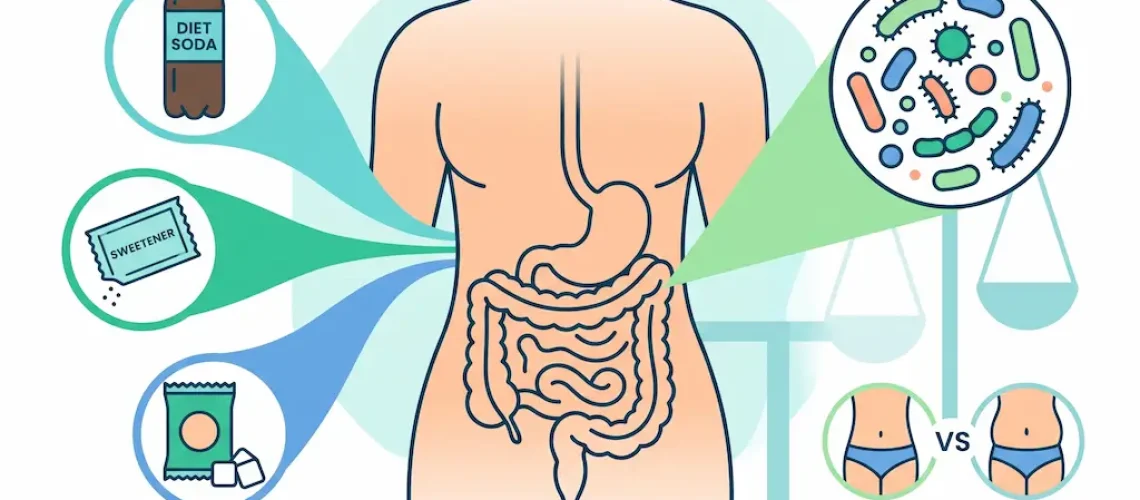
There’s ongoing discussion around whether artificial sweeteners negatively affect gut health. Some people believe they may disrupt the gut, while others argue the evidence shows little to no effect.
What is gut health?
Gut health can generally be looked at in two ways.
The first relates to the gut microbiome, including the amount, variety, and balance of bacteria living in the digestive system. Certain bacteria are often associated with positive health outcomes and are commonly referred to as ‘good’ bacteria, while others are considered less beneficial. Of course, the reality is more complex than simply ‘good’ versus ‘bad,’ but overall gut health is often linked to maintaining a balanced and diverse microbiome.
The second aspect of gut health involves digestive symptoms such as bloating, gas, constipation, or diarrhoea. In many cases, having minimal or no ongoing digestive symptoms can also be considered a sign of good gut health.
When looking at the overall evidence on artificial sweeteners and gut bacteria, the findings are inconsistent.
- Results across studies are mixed
- Animal studies tend to show stronger associations
- Human studies usually report smaller or non-significant effects
- Some caution may still be reasonable when consuming artificial sweeteners regularly
Many people report that artificial sweeteners trigger digestive symptoms such as bloating or stomach discomfort. However, this can be difficult to interpret because several other factors are often involved.
For example, diet soft drinks are carbonated. If someone experiences bloating after drinking them, it may be difficult to determine whether the carbonation or the sweetener was responsible. Similarly, sugar alcohols which are commonly used in ‘sugar-free’ products are well known for causing digestive symptoms in some people. But again, they are different from the sweeteners being discussed in this article.
When sugar alcohols are excluded, the consensus is that artificial sweeteners may cause digestive symptoms in some individuals, but this appears to be relatively uncommon at typical intake levels.
In theory, if artificial sweeteners altered gut bacteria, this could potentially influence digestion or gut comfort. However, research has not consistently shown strong links between these sweeteners and symptoms like bloating or diarrhoea.

Aspartame, sucralose, saccharin, and Ace-K are mostly absorbed or eliminated before they reach the colon in significant amounts. Because of this, they generally do not ferment in the gut or produce gas, which helps explain why most people tolerate them well. Overall, artificial sweeteners seem to be an uncommon trigger for gut symptoms, although some individuals may be more sensitive than others, particularly at higher intakes.
Human research has consistently shown either smaller effects or no significant impact of artificial sweeteners on gut health. Still, there is enough uncertainty that some level of caution may be reasonable. There is also likely to be individual variation in tolerance and response so choosing to limit or avoid artificial sweeteners is also a reasonable approach if that aligns with your preferences or if you notice they affect how you feel.
At this stage, moderate consumption of artificial sweeteners appears to be safe for most people. In many situations, they are probably less concerning than several other lifestyle or dietary habits that can negatively affect health.