

Your brain has a built-in fire alarm designed to keep you safe, this is your nervous system. Chronic Pain
When you get a new injury, like a twisted ankle, low back pain or a broken bone this system blares loudly to protect you. This is called acute pain. It’s a normal and necessary response that tells you to protect the injured area. Once the injury heals and the danger is gone, the alarm should go quiet, and you can get on with your life.
But what happens when that alarm keeps ringing loudly, long after the injury has healed and the danger is gone? This is the core of chronic pain, a condition that affects roughly 3.6 million Aussies. It’s not a sign that you’re “imagining” the pain or that you’re weak. It’s a complex condition where the brain’s “fire alarm” system itself has become overly sensitive and a bit haywire.
The Fire Alarm Analogy: How It Works
The Fire (Acute Pain): This is a real, physical injury or threat, like a sprained ankle, a cut, or a broken bone. Pain signals (the “alarm bells”) travel from the injured area to your brain. This is incredibly helpful it makes you rest the injured ankle and protect the cut, allowing it to heal.
The Alarm That Won’t Turn Off (Chronic Pain): With chronic pain, something has gone wrong with the alarm system itself. The initial “fire” is out the ankle has healed yet the alarm continues to ring.
Your brain has become hyper vigilant. It’s been on high alert for so long that it now sees threats everywhere. A gentle touch, a simple movement, or even no external signal at all can be mistaken as a major threat, causing the alarm to blare.
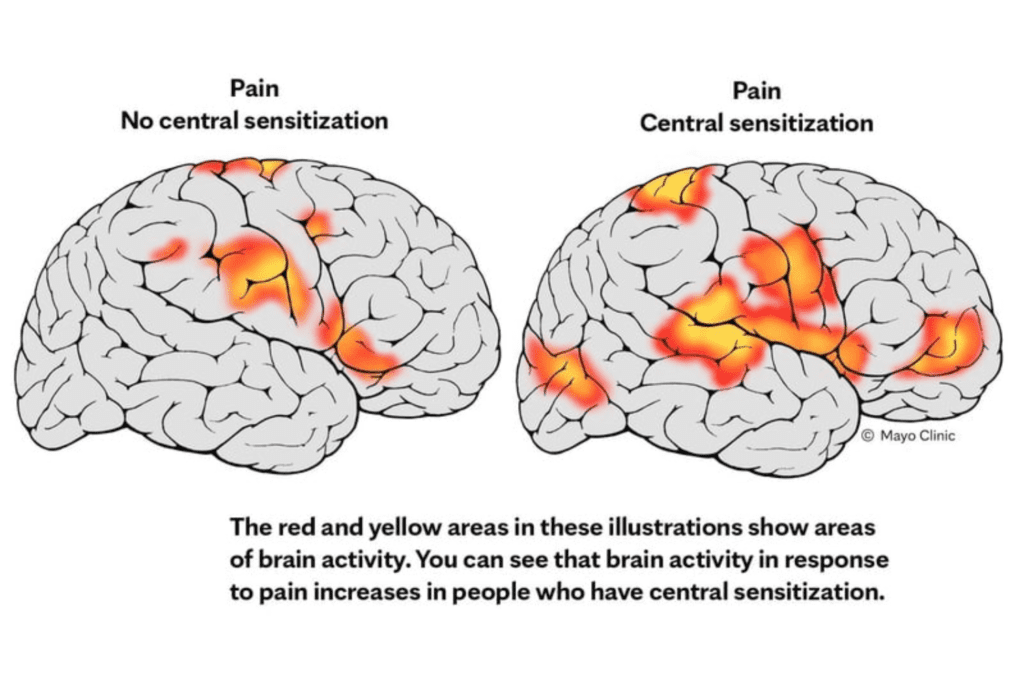
This happens through a process called central sensitisation. Your nervous system, especially in the spinal cord and brain, gets “rewired.” The volume on pain is cranked up and gets stuck there. Normal sensations that shouldn’t be painful are processed by the brain as pain signals.
Common Misconceptions
Understanding the fire alarm analogy helps clear up some common and damaging myths about chronic pain:
- “It’s all in your head.” This is perhaps the most hurtful myth. While chronic pain is heavily influenced by the brain, the pain is absolutely real. The sensations are not imagined. The “fire” might be out, but the “alarm” is a very much a reality. The pain signals are just as real as if you were touching a hot stove, even if there’s no visible injury.
- “You just need to push through it.” Forcing yourself to “tough it out” can often make the problem worse. Pushing through can over stimulate an already hypersensitive nervous system, leading to a pain flare up.
- “It must be a sign of ongoing damage.” For many people with chronic pain, this isn’t true. Your scans might show nothing wrong, and a doctor may tell you your tissues have fully healed. This is confusing and frustrating, but it’s a key part of the puzzle.
Turning Down the Volume
How do you fix a faulty system? The goal isn’t to find a cure for a broken body part but to calm and retrain the nervous system.
This is why treatments for chronic pain often focus on teaching the brain to be in a calmer state. This can include:
- Pacing and Graded Activity: You learn to listen to your body and do activities in a gradual, controlled way. This shows your brain that movement is safe and not a threat.
- Gentle Exercise: A skilled osteo or physio can guide you through safe movements that reintroduce normal patterns to your body.
- Cognitive Behavioural Therapy (CBT): A therapist can help you identify and change negative thought patterns that may be making your pain worse.
- Mind Body Therapies: Techniques like meditation and yoga can help you consciously calm your nervous system.
Chronic pain is a deeply frustrating and often misunderstood condition. You aren’t “broken.” Your brain is simply trying to protect you, but it’s stuck in an overprotective mode. The journey to recovery is about teaching it that it’s safe to turn the alarm down.
Dr Daniel Raab
Osteopath
E: Daniel.Raab@staytuned.com.au