
Long flights and busy holiday travel can have a detrimental effect leading to lower back and neck pain. Sitting for long periods in a cramped chair and a stuffy environment can create and exacerbate musculoskeletal complaints.
It’s not the ideal way to start (or end) a long-awaited holiday, whether you’re heading to a long-awaited tropical destination or travelling domestically to see family.
Luckily enough there are some very simple things that are easy to do that can reduce the chance of aggravating your lower back and neck.
1. Drink lots of water before and during your flight.
This works on many different levels.
- Drinking lots of water will leave you feeling less jetlagged and less dehydrated post flight.
- Water keeps your joints and discs hydrated which in turn reduces stiffness and decompression of your spine.
- It makes you need to go to the toilet. This means you have to be mobile throughout the flight.
2. Every hour, get up and walk for five minutes around the cabin.
Not only does it increase circulation and help prevent Deep Vein Thrombosis (DVT), but it reduces stiffness in the joints and tightness in your muscles.
3. Complete some easy stretches for your lower back every hour.
Hold each stretch for 30 seconds and repeat 1 to 3 times each.
- Seated glute stretch
- Calf stretch
- Hamstring stretch
- Flank stretch
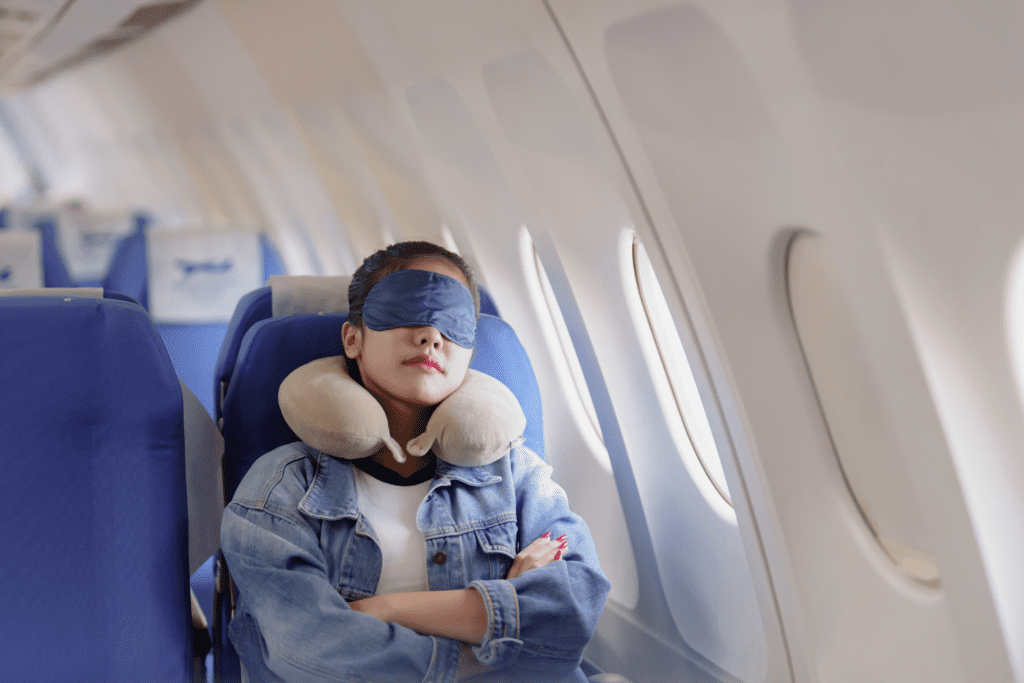
4. Carry a good travel pillow, preferably not a blow up one, so your neck is as supported as possible.
Also carry socks so that you don’t get cold feet and tense up. An additional pillow to place under your feet or at the small of your back is also very useful.
5. Purchase blow up lumbar supports.
If you have a history of lower back pain, before your flight it is possible to purchase convenient blow up lumbar supports to fit into the small of your back while you are sitting.
This helps to maintain the normal curve in your lower back, promoting excellent alignment and helps you to maintain good posture.
6. Complete some easy stretches for your neck every other hour.
Hold the stretches for 30 seconds and repeat 1 to 3 times.
- Trap stretch
- Pec stretch
- Rotator cuff stretches
- Shoulder shrugs and circles.
7. Research prior to your flight where the best seats are on the plane.
The website seatexpert.com has done all the research for you. Type in the plane model that you are flying, it will outline the pros and cons of all the seats. You can then try to request one that will best suit your needs for the flight. Optimally, seats that recline fully or the pods in first class and business class are the best for your back.
As a general rule, requesting an aisle seat or exit row means more leg room and avoiding seats near the toilets where people queue will prevent being bumped into. The last row of chairs in an aircraft generally don’t recline.
8. Heat and Ice Packs.
It is possible to purchase heat and ice packs that can be activated without the use of a microwave. Consider purchasing a small quantity of these to provide symptomatic relief of any back or neck pain. Be sure not to burn yourself. It is recommended to place a piece of cloth or clothing between you and the heat/ice pack. Also take note of the liquid content in the heat or ice pack. Make sure the volume does not exceed that of airline allowances.
9. Medication.
Speak to your pharmacist or GP regarding appropriate medication that might assist you if your back becomes irritated during the flight.
10. Pre-research an appropriate health care practitioner.
In the event that you do aggravate your back and neck during the flight, it is useful to have pre researched an appropriate health care practitioner that you could visit conveniently. This not only cuts out a lot of hassle that wastes time in your trip but also gives you some piece of mind. If you are super organized, requesting a letter from your current health care practitioner describing your back pain complaint and current management will help the new practitioner to get a handle more quickly on your presenting complaint.
Last but not least, please don’t forget your DVT exercises that can be found in the airplane magazine.
Want to learn more? Our practitioners are here to help; simply click here to make a booking.
Dr Paul Hermann
Titled Advanced Sports Osteopath & Titled Advanced Exercise Rehab Osteopath