
Introduction:
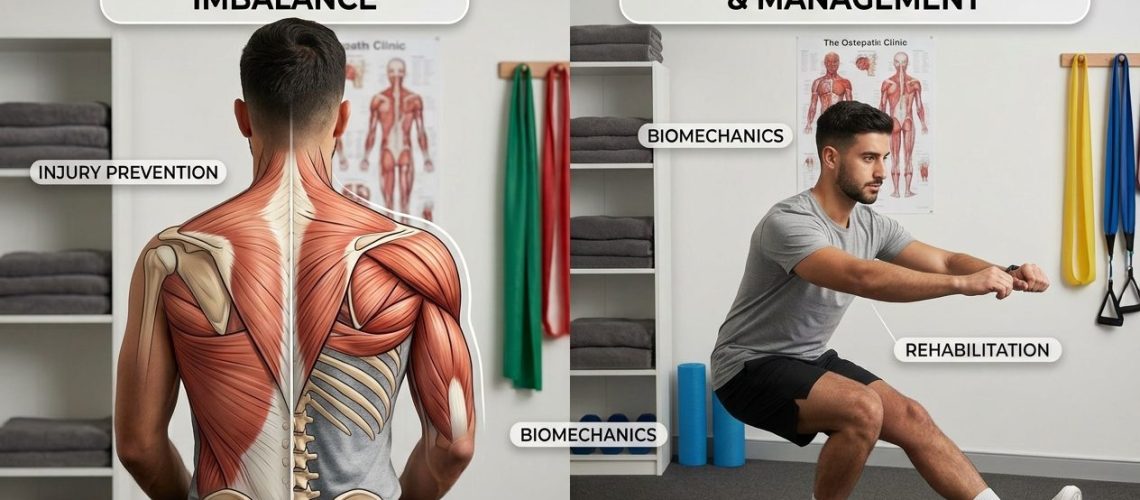
A lot of us play sports that are single-sided. This may include a dominant right foot kick, or a one handed back-hand in tennis or a left arm bowler in cricket. It is very common to have one side of our body stronger than the other. Is it important to know? Yes.
Why?
- Addressing muscular imbalances may play a role in injury prevention (Zhou & Liu, 2025).
- Imbalances can have an impact on our biomechanics and may alter how we distribute load through our body (Enqvist et al., 2025)
- Not only are we trying to prevent injury – the research suggests that addressing muscular imbalances and asymmetries may help with physical performance (Sun et al., 2025)
So, what is an Osteopath’s Role?
- History Taking (Gaining an understanding about you)
- Physical Assessment (Range of Motion Testing & Functional Movements)
- Initial Baseline and Re-testing (Assessing your strength/force production)
- Structured tailored exercise rehabilitation program – for your goals
Wrap Up:
Having a stronger side of your body is normal. However, knowing how you move can be important for your body’s physical preparation and injury prevention. It can be helpful in getting your body prepared for sport and may play a role in injury prevention.
If you have any questions regarding this topic, email me: Faysal.soufi@staytuned.com.au
Enqvist, J., Holmberg, L. J., Andersen, M. S., & Arndt, A. (2025). Ground reaction force asymmetry underestimates asymmetries in knee joint reaction forces during countermovement jumps. Journal of Biomechanics, 189, 112834. https://doi.org/10.1016/j.jbiomech.2025.112834
Sun, W., Li, H., Qu, L., Zhou, Y., Cao, X., Wang, K., & Li, K. (2025). Unilateral plyometric training effectively reduces lower limb asymmetry in athletes: A meta-analysis. Frontiers in Physiology, 16, 1551523. https://doi.org/10.3389/fphys.2025.1551523
Zhou, S., & Liu, H. (2025). Injury risk analysis of movement restriction and body asymmetry in sports injury prediction. BMC Sports Science, Medicine and Rehabilitation, 18(1). https://doi.org/10.1186/s13102-025-01465-z